
Mentorship
Discover a New Exoplanet
On this course, a student searches real data from NASA’s TESS space telescope for the signal of a planet that nobody has yet confirmed, checks with a ground-based telescope that the signal is real, and measures the planet’s size and orbit — the same steps a professional astronomer follows.
An exoplanet is a planet that orbits a star other than the Sun. The first was found in the 1990s. Most of the planets known today were found by watching for a small, regular dimming of a star’s light as a planet passes in front of it; a graph of the star’s brightness over time is called a light curve. Since 2018, TESS has found almost 10,000 such signals. Each one is only a candidate until it has been checked with further observations, because two stars orbiting each other can produce a similar dimming. Fewer than half of these candidates have been checked, because there are not enough astronomers to do it.
The course consists of 14 one-hour sessions, delivered online, one-to-one or in small groups, and ends with a completed research project written up as a paper. The three stages are:
- Writing their own computer program to search TESS light curves for the repeating dimming that a planet produces, and running it on a set of stars to find candidates
- Analysing images from a ground-based telescope to check that the candidate is a planet and not a pair of stars
- Fitting a statistical model to all the data to measure the planet’s size and its distance from the star, with proper uncertainties
Work from this course has stood on its own outside it. In 2026, a student’s paper was selected for a poster presentation at the Australian Institute of Physics Congress and is under revision at the National High School Journal of Science; former students have gone on to continue their research with me beyond the course.
Skills
The skills that the student will develop throughout the course include:
- An intimate knowledge of the theory underpinning transiting exoplanets and observational astronomy
- Literacy in statistics and the concept of uncertainty: probably the biggest change in mindset between learning theory and performing and communicating research
- Practical experience of writing code and applying it to large datasets to undertake research. Throughout the course we will be using the Python programming language, which is used abundantly in astrophysics research
- A genuine taste of what it feels like to do real scientific research — including the satisfaction of uncovering something that nobody has measured before
Platform
Google Colab is a free, browser-based platform that allows the student to write and run Python code without installing anything on their computer. I use it to deliver all aspects of the course — theory is presented through interactive notebooks containing text, equations, and figures, many of which the student can manipulate directly to explore the underlying concepts. The same environment is then used for the research exercises themselves, where I provide scaffolding code to handle routine tasks, allowing the student to focus their efforts on the parts of the analysis where the real science happens.
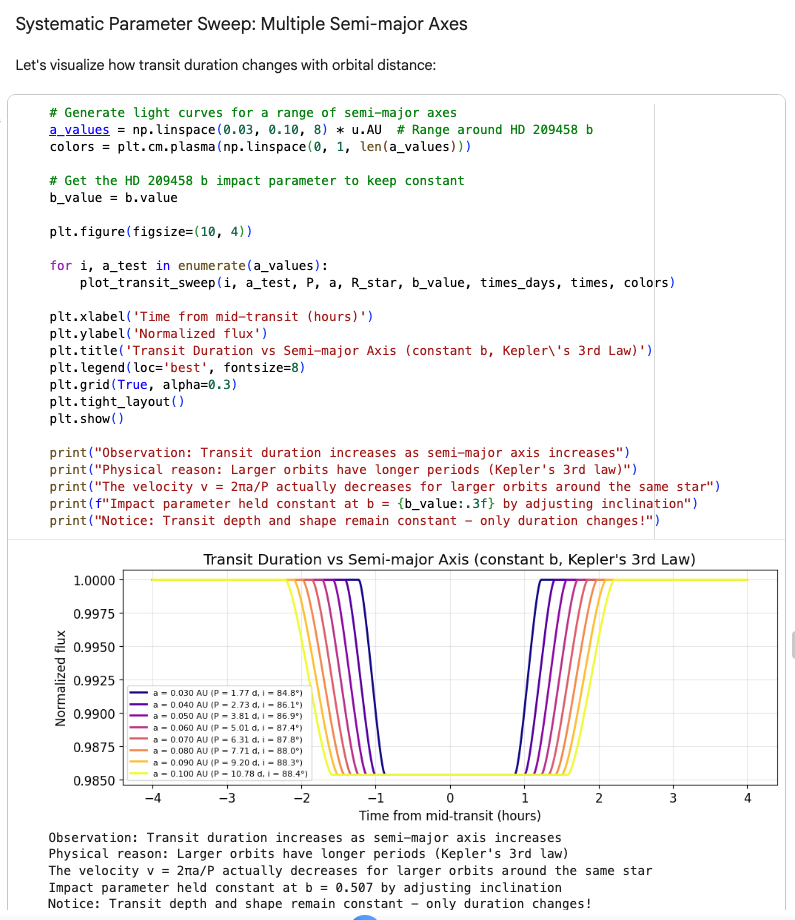
Students should already be comfortable with the basics of Python — variables, loops, functions — but no experience of scientific programming is needed; the course develops that progressively.
A small number of places are available each year. The programme is delivered online, making it accessible to students worldwide. Fees are available on request. To enquire about availability or to find out whether the programme is suitable for your student, please use the contact form.