
Research
The migration of ultra-hot Jupiters
The discovery of the first hot Jupiter in 1995 exposed our understanding of the processes that shape planetary formation and evolution as highly primitive. Deciphering these processes, given the fleeting glimpse we have of systems evolving on Myr and Gyr timescales, is one of the biggest challenges of modern-day astrophysics. It is possible that the dominant mechanism explaining the existence of such large planets at small separations is high-eccentricity tidal migration: a two-step process whereby a Jupiter-sized planet at a few AU is first perturbed onto an eccentric orbit, and then migrates inwards as interactions with the host star tidally dissipate its energy during the periastron passages.
Alongside the eccentricity, each perturbing mechanism has its own distinct impact on the stellar obliquity Ψ, defined as the angle between the planes of the stellar equator and the planetary orbit. While the eccentricities of hot Jupiters diminish during their inward migration due to tidal dissipation, a large proportion of them (especially those orbiting stars hotter than the Kraft break) are observed to have significantly misaligned orbits. Although attempting to use obliquity measurements to piece together the evolution of hot Jupiters is fraught with difficulties, targeting young stars with newly formed planets presents us with an opportunity to focus directly on the processes that shape formation and the early stages of any post-formation migration.
A novel way to make a measurement of Ψ involves observing the transits of hot, early-type stars. In a phenomenon known as gravity darkening, the rapid rotation that these stars commonly exhibit causes their equators to bulge, making them cooler and less luminous than the stellar poles. This breaks the approximate radial symmetry of the stellar disk that we observe for later-type stars, meaning that the transit light curves exhibiting gravity darkening directly encode the value of Ψ, which is generally eluded by other methods to quantify the stellar obliquity. Unfortunately, the complexity of the models needed to fit these subtle brightness variations mean that the measurement of Ψ is highly sensitive to systematics, as well as subtle differences in the models and fitting methods.
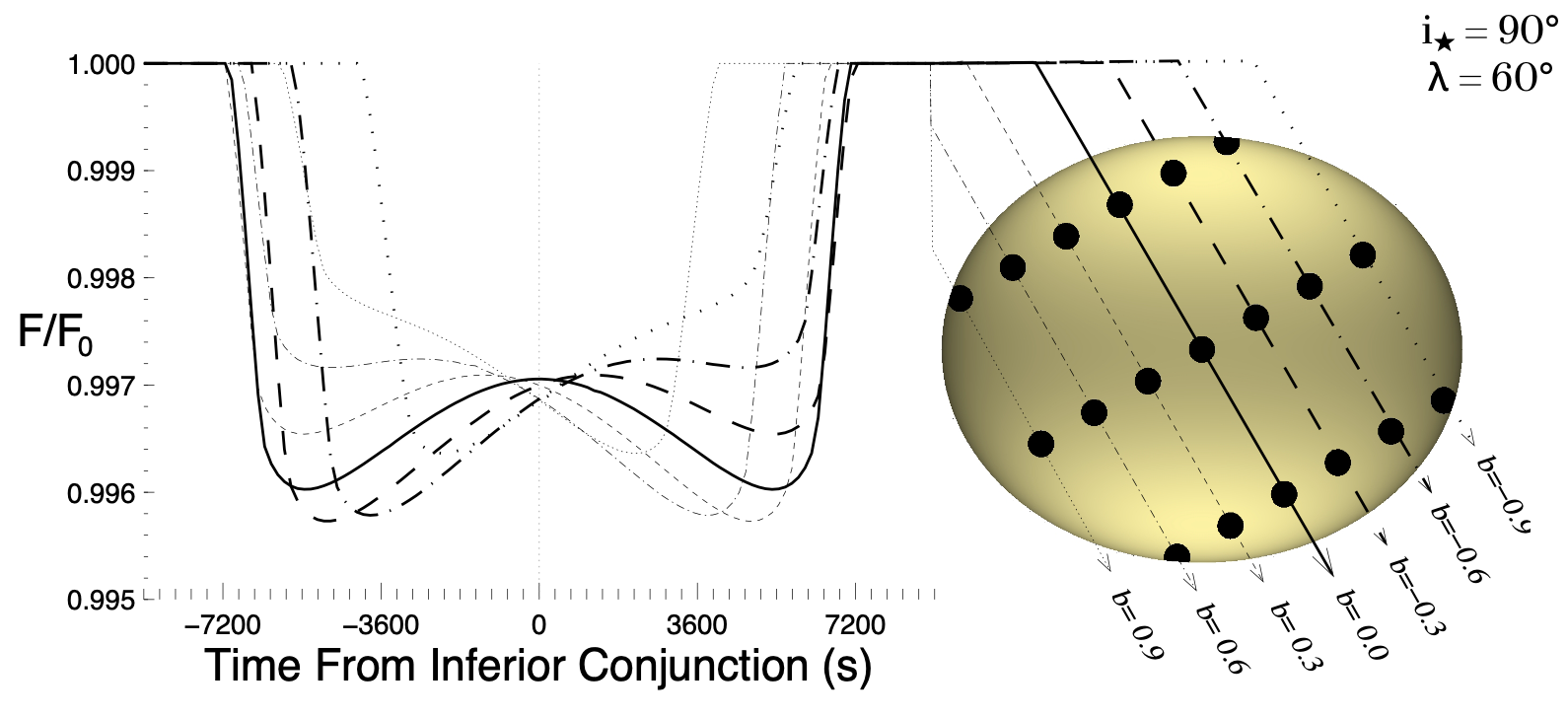
My analysis of CHEOPS and Spitzer light curves of ultra-hot Jupiter MASCARA-1b demonstrated that the use of multi-colour photometry greatly diminishes the errors observed. The launch of JWST achieves an order of magnitude better precision in the light curves of the exoplanets that it will observe, allowing us to observe this effect for smaller planets for the first time. I am currently in the process of consistently reanalysing all existing multicolour photometry of exoplanets transiting rapidly rotating stars with the aim of identifying trends in Ψ and eccentricity that could help to identify the processes shaping any high-eccentricity tidal migration that has occurred in their dynamical histories.
The atmospheres and dynamical history of multi-planet systems
In 2021, I was part of the team that discovered six terrestrial planets orbiting the nearby star TOI-178, five of which are in a chain of Laplace resonance. This rare configuration — observed in a handful of systems such as TRAPPIST-1 and the Galilean moons of Jupiter — guarantees dynamical stability over billions of years, all the way back to the very formation of the system. I will shortly be publishing the results of my JWST/NIRSpec observations of three planets in the system, with the aim of diagnosing whether they formed in situ or migrated to their current positions with respect to different molecular snow lines — the distances from the star at which different molecules freeze out. This would be achieved by constraining the abundances of key molecules in their atmospheres, including water, carbon monoxide, and carbon dioxide, whose relative proportions carry the fingerprints of where and how the planets formed.
SPECULOOS
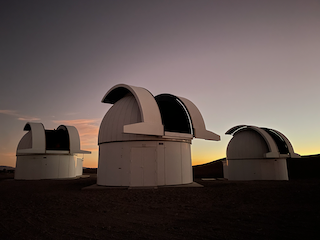
SPECULOOS (Search for habitable Planets EClipsing ULtra-cOOl Stars) is a network of robotic 1-metre telescopes designed to search for transiting Earth-sized planets around nearby ultracool dwarf stars — the smallest, coolest, and most abundant stars in the galaxy. It is a direct successor of the TRAPPIST mission, which with smaller telescopes and a smaller sample of targets discovered the TRAPPIST-1 system, a hallmark system of seven Earth-sized planets, three of which lie within their host’s habitable zone. The ultimate goals of the project are to reveal the frequency of temperate terrestrial planets around the lowest-mass stars and brown dwarfs, to probe the diversity of their bulk compositions, atmospheres and surface conditions, and to assess their potential habitability. These targets are particularly valuable because their small size and low luminosity make it far easier to detect and characterise small planets than around Sun-like stars, especially with JWST. The project is led by the University of Liège and conducted in partnership with the University of Cambridge, the University of Birmingham, MIT, the University of Bern, and ETH Zurich.
I support the SPECULOOS mission by developing the reduction and analysis pipeline for all data from the project, which is hosted on an archive here at Cambridge. In recent years, this has enabled two unique SPECULOOS planet discoveries and the confirmation of dozens of transiting exoplanets first identified by the TESS mission. In addition, my PhD student Clàudia Janó Muñoz is designing the pipeline for and optimising the performance of SPIRIT, SPECULOOS’s new near-infrared camera.
CHEOPS
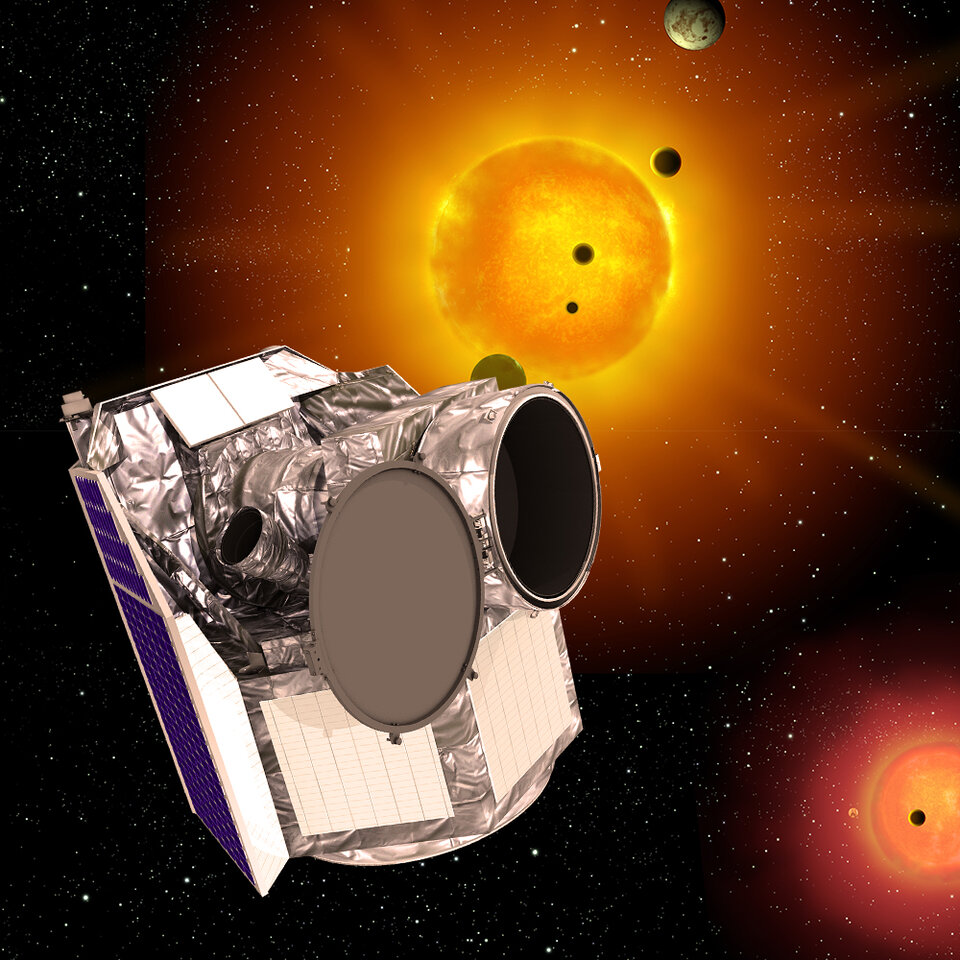
CHEOPS (CHaracterising ExOPlanet Satellite) is ESA’s first space mission dedicated to studying bright, nearby stars already known to host exoplanets, making high-precision observations of planet sizes as they pass in front of their host stars. By combining precise size measurements with known planetary masses, CHEOPS allows the density of a planet to be estimated, constraining its possible composition and structure — indicating, for example, whether it is predominantly rocky or gaseous, or perhaps harbours significant oceans. Unlike previous missions that focused on discovering new worlds, CHEOPS follows up on the ever-growing catalogue of known exoplanets, characterising them in order to understand their place in the Universe. The mission launched on 18 December 2019 and is the first Small-class mission in ESA’s Cosmic Vision science programme.
I have led the analysis of CHEOPS observations published in many papers, in particular in the discovery of multi-planet systems and characterising the atmospheres of hot Jupiters. I continue to support the mission by coordinating a campaign to apply for JWST time to follow up our most interesting targets. I previously led the CHESS programme, with the aim of refining the radii of systems of multiple small transiting exoplanets, the results of which have been presented in dozens of publications in recent years.
The QUB secondary eclipse campaign
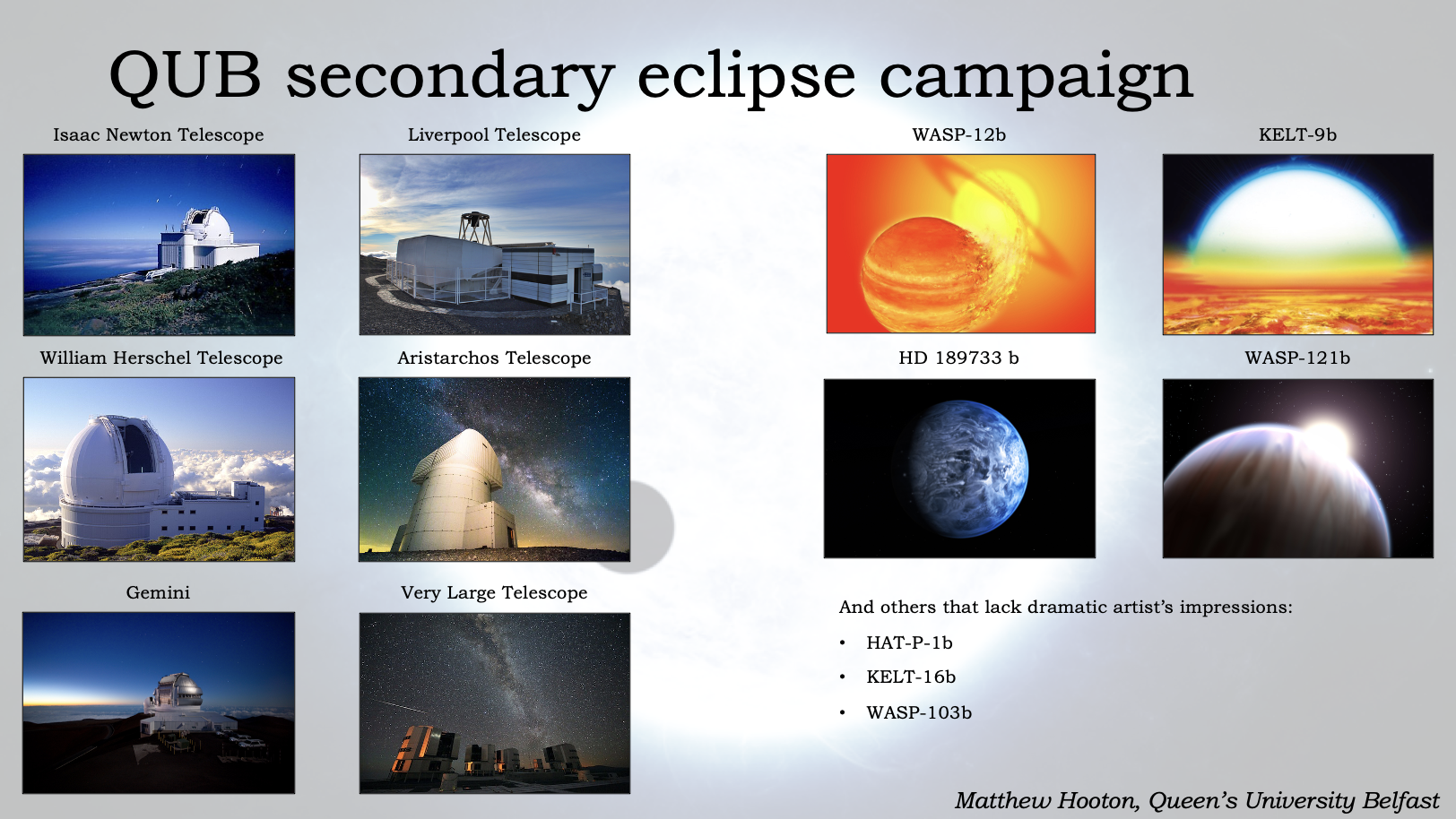
The Queen’s University Belfast (QUB) secondary eclipse campaign, which I designed and led during my PhD, specialised in ground-based observations of hot Jupiters in wavelength bands not routinely covered by Hubble or Spitzer. Leading this project involved target selection; proposing for competitive telescope time on facilities such as the VLT and Gemini-North; coordinating a team of QUB astronomers to perform observations; reducing and analysing the resulting data using a self-written bespoke analysis package; collaborating with theorists to provide interpretation for our results and bringing the work to publication.
Our 3-sigma U-band upper limit of 181 ppm on the eclipse depth of KELT-9b — the first time such an observation had been conducted from the ground — placed strong constraints on its thermal emission and temperature profile. Our i-band eclipse depths of WASP-12b hinted at temporal variability in the thermal emission properties of hot Jupiters. Ongoing studies involved a detailed multi-colour characterisation of WASP-103b and red-optical emission spectroscopy of KELT-16b and WASP-121b. In addition, I assisted in the supervision of a PhD student at QUB who presented an analysis of TESS observations of WASP-12b.